Choosing a university is one of the most important decisions you will make in your life. It shapes careers, friendships, networks, and even where you end up living. 86% of young people believe university significantly shapes long‑term success, and 87% of parents see it as a crucial life opportunity (University of Lincoln & YouGov 2025). It is high-stress, high-stakes, high-interest. Far more meaningful than picking a mortgage provider or choosing your next phone.
So why are some higher education institutions so bad at helping people make this choice?
University brands stuck in Default
Our Brand Divergence Index (BDI), which measures a brand’s levels of Difference and Attraction, shows universities have some of the lowest scores of any category we have analysed.
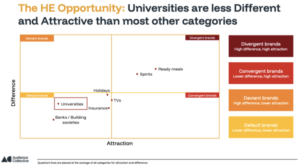
Most UK institutions sit firmly in Default territory – indistinguishable, interchangeable, forgettable. They give audiences no compelling reason to choose them.
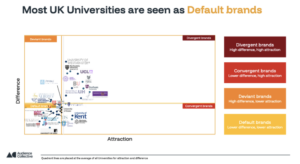
The category is suffering from a chronic sameness problem. But not because universities lack marketing spend. HE pours more than £30 million a year into advertising, with some institutions investing over £1 million each (Nielsen 2025). Universities do not need bigger budgets; they need bigger bravery.
Most universities offer similar sounding courses and talk about the same three things -teaching quality, reputation and employability. They lean on awards no student or parent has ever heard of, and all claim to be “world-class” and “future-focused” clichés. A recent analysis of Russell Group taglines showed they’re almost identical in positioning.
Their visuals are not much better. Smiling students in branded hoodies, staged diversity, laptops in the park and a frisbee thrown somewhere in the background. Even HE marketers agree, with 72% saying they find university brands indistinguishable.
Conventional Marketing is Costing Universities
With student numbers dipping for the first time in nearly a decade, driven fall in the number of 18-year-olds, declines in domestic applicants and volatile international recruitment, the pressure is on. Even Russell Group universities are facing thousands of unfilled places.
Competition has never been fiercer. With 160 universities in the UK, every institution now needs a crystal‑clear competitive edge. A differentiated brand with an attractive proposition. Because the BDI proves what brands in other sectors already know – do things differently, and you can outgrow your category.
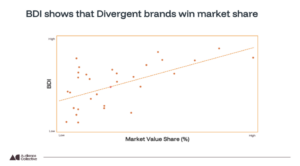
When universities differentiate, students choose
So where can universities look for inspiration? A handful of Divergent brands already show what is possible. UCL and the University of Manchester both score highly on Difference and Attraction, proof that when you stop blending in, you start breaking through.
Manchester has built its reputation by refusing to follow conventions. They combine advertising with sharp international and national outreach, all anchored in a student-first creative approach. For example, their recent humorous UGC-style employability campaign turned the everyday worries of nagging parents into a springboard for championing their Arts and Humanities degrees as real career enablers.
The executions were playful, instantly engaging and designed to hook attention within seconds; exactly what short-form social demands. Perfect for their media mix of Instagram, TikTok, YouTube, and Snapchat. Their distinctive, divergent marketing is delivering market-beating levels of awareness and consideration.

UCL have expanded their reach by refusing to stick to the usual HE media playbook. Instead of relying on the same safe performance platforms like Search and Affiliates, they have built a media mix that reflects the cultures, nationalities and platforms their audiences live on.
They have added awareness drivers like Reddit, Quora, DemandGen and TikTok for a far more relevant, contemporary footprint. And to engage students who may be nervous about attending university, they have leaned into UGC-style creative led by real student champions, sharing everyday experiences that feel recognisable, human and genuinely lived. It is a world away from the generic campus tour gloss of other universities. Their marketing is working because it shows prospective students a version of university life they can see themselves living.
These two progressive brands prove that outsmarting always beats outspending, especially in HE. Our message for marketers is simple: Higher Education is not a category lacking investment; it is a category lacking imagination. The universities winning today are the ones breaking away from conventions and building brands with edge, emotion and unmistakable Difference.
It’s actually a pretty easy fix
Get in touch, and we will show you what the Brand Divergence Index really means for your brand. Our study covers 9,000 UK consumers, 214 brands and 13 categories. Insights are generated from over one million data points run through 49 advanced models. That means we can pinpoint the strongest predictors of perceived Difference and real-world attraction in your category.
If you want to understand how to outthink your competitors, we can show you exactly where to start. Reach out, and we will share deeper, specific insights from the Brand Divergence Index and help you set a truly Divergent direction for growth.